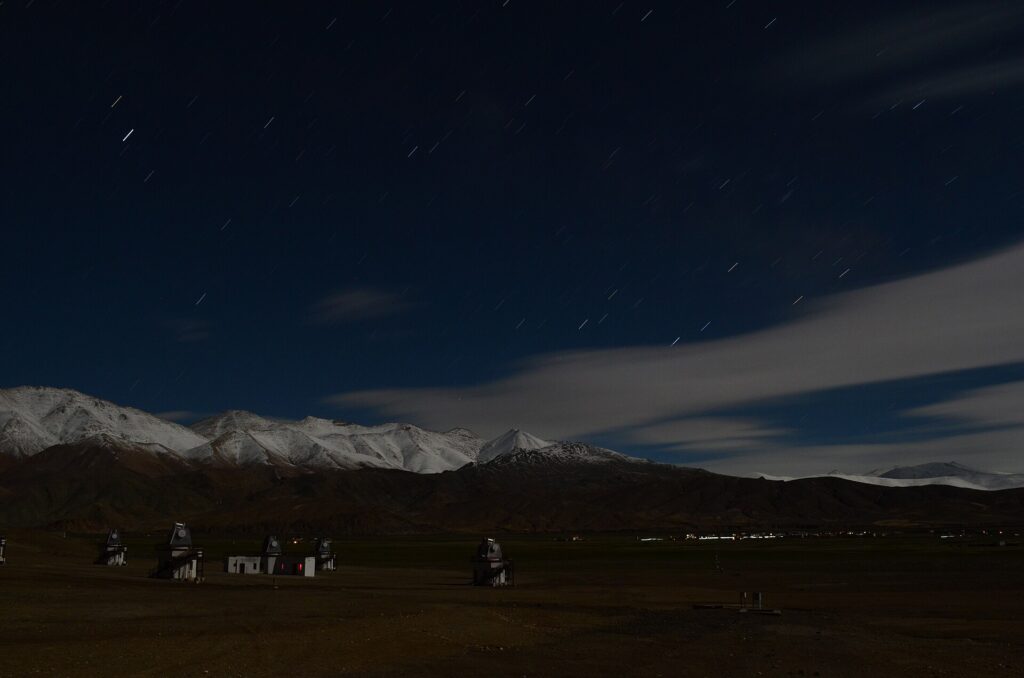
In Hanle, a village 14,764ft up in India’s Himalayan Ladakh region, four women in their late twenties have become the local astro-ambassadors. BBC Marathi reports that Palzes Angmo, Tsering Dolker, Tsering Yangdol and Padma Chamchot run their family homestays by day — cooking, cleaning, looking after guests — and by night set up telescopes and trace constellations with laser pointers for visitors who have travelled hundreds of kilometres to see a sky the four grew up thinking of as ordinary.
Hanle’s altitude, dry air and near-total absence of light pollution give it roughly 260 usable observing nights a year, and it is home to the Indian Astronomical Observatory. It became India’s first Dark Sky Reserve in 2022, and that same year the Ladakh administration and the Indian Institute of Astrophysics put 24 local young people through 15 days of astronomy training: identifying stars and planets, operating telescopes, photographing the Milky Way on a phone. Visitor numbers have climbed from about 3,000 a year five years ago to nearly 30,000 in 2024-25.
Evenings now start at about 9pm, and at 11pm the whole village switches off its lights so the galaxy comes out properly. The four, who were at first nervous of breaking the equipment, talk visitors through Saturn’s rings and the craters of the Moon, and help them get the settings right to photograph the Milky Way themselves.
Source: BBC News