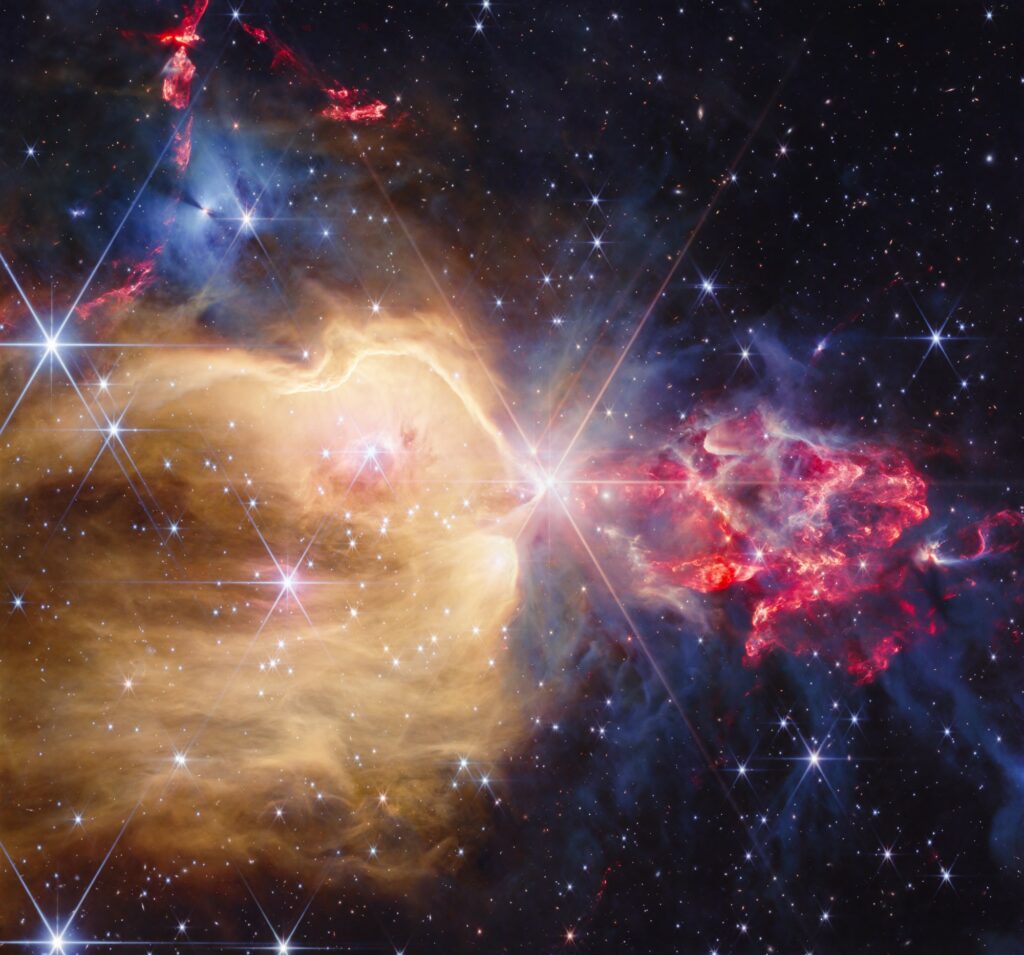
The James Webb Space Telescope has turned its infrared eye on NGC 7129, a cloud of gas and dust about 3,300 light-years from Earth where stars are still being born.
NASA, which published the image this week, says Webb’s near-infrared camera can see through dust that blocks ordinary light, revealing young stars and protostars that earlier telescopes could not pick out. The brightest object in the frame is a star between five and eight times the mass of the Sun that has not yet settled into adult life.
Beside it lies a golden cavity around 3.5 light-years wide, hollowed out of the surrounding cloud. Gold marks hot hydrogen gas, while red traces cooler hydrogen that has been jolted by jets streaming from the infant stars. One protostar is ringed by a doughnut-shaped disc of material that throws a long shadow across the nebula, much like the ‘Bat Shadow’ seen elsewhere in the sky.
Views like this let astronomers study the very beginning of a star’s life, the stage our own Sun went through some 4.6 billion years ago.
Source: NASA